
The Lewis and Clark Expedition
U.S. expedition to explore the Louisiana Purchase and reach the Pacific.

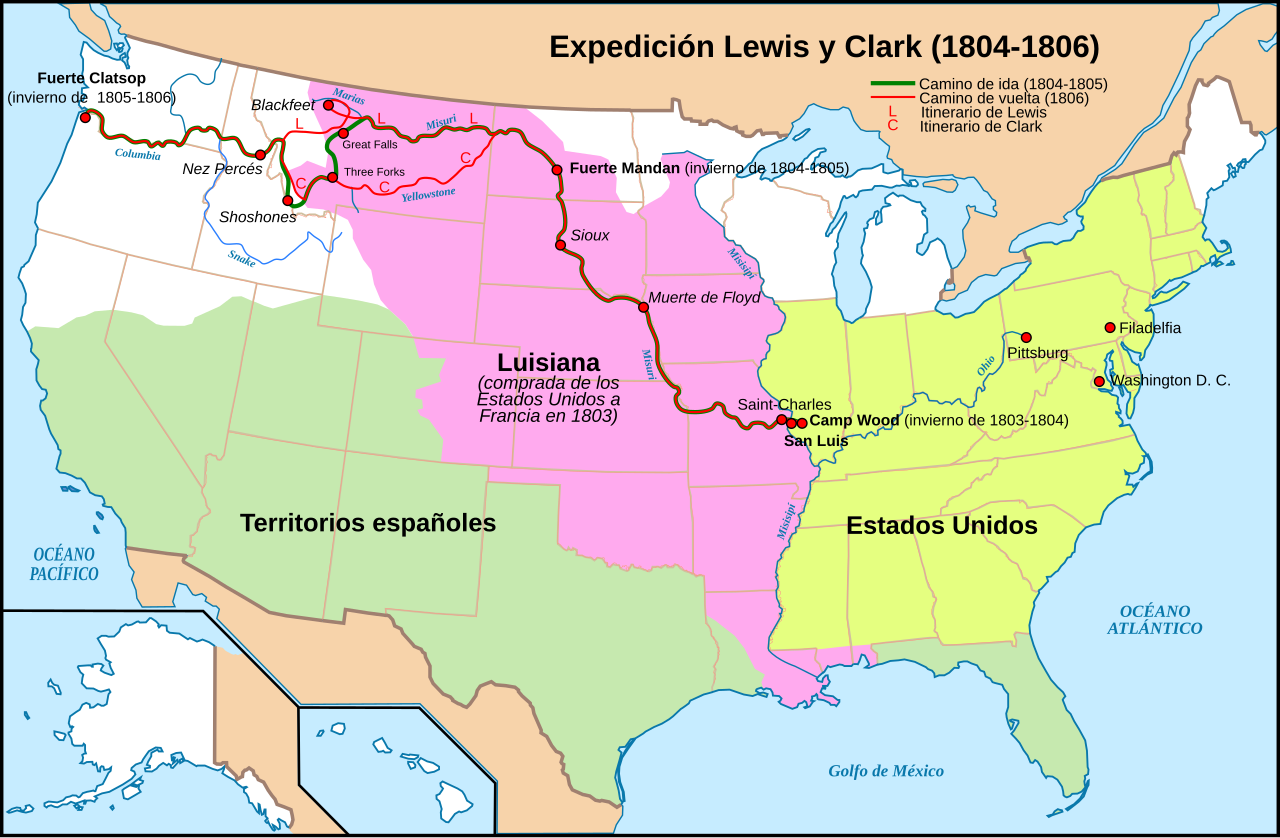
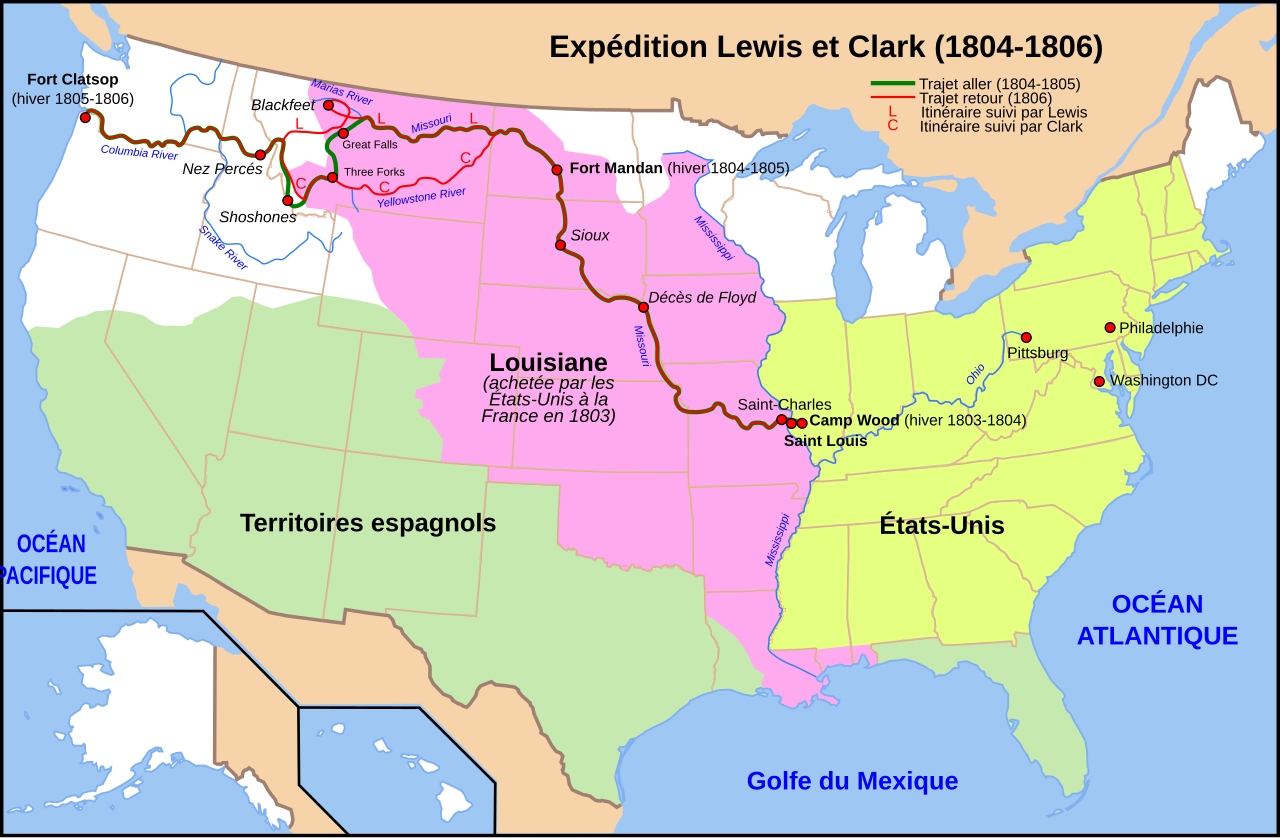
Carte Lewis-Clark Expedition-fr.svg : Sardon derivative work: rowanwindwhistler · CC BY-SA 3.0
The Lewis and Clark Expedition, also known as the Corps of Discovery Expedition, was a United States expedition to cross the newly acquired western portion of the country after the Louisiana Purchase. The Corps of Discovery was a select group of U.S. Army and civilian volunteers under the command of Captain Meriwether Lewis and his close friend Second Lieutenant William Clark.
- field
- Exploration
- nationality
- United States
- known_for
- First U.S. overland expedition to the Pacific coast and back
Lore & Background
Secondary objectives were scientific, economical, and humanitarian: to document biodiversity, topography, and geography, and to establish trade relations with Native American tribes. Jefferson's main goal was to find 'the most direct and practicable water communication across this continent, for the purposes of commerce.'
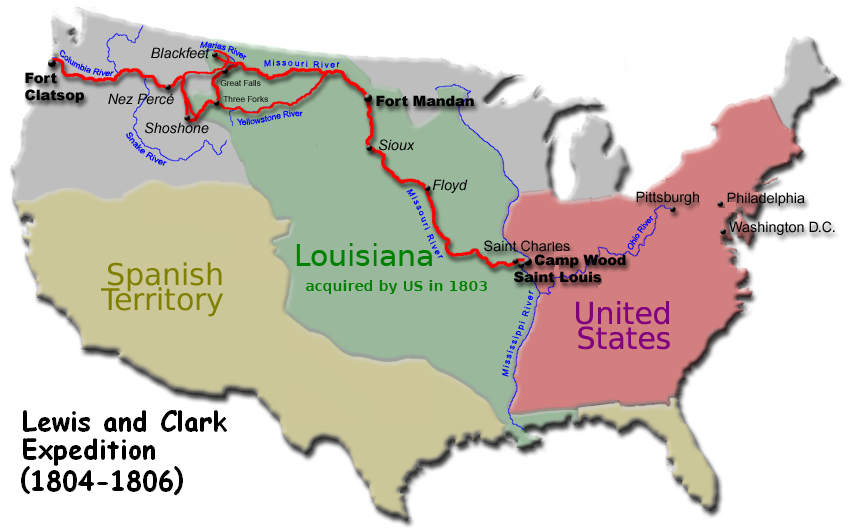
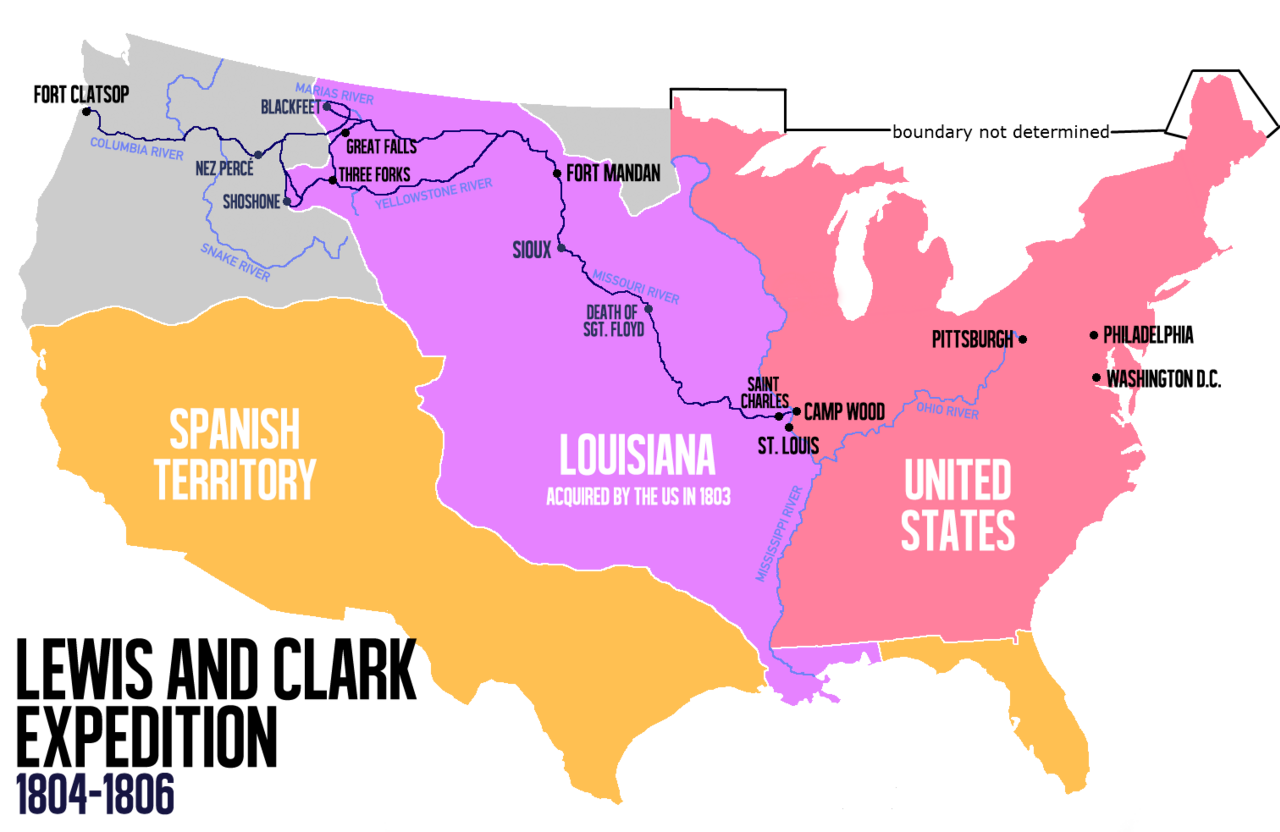
Jefferson had long been interested in exploring the western frontier, influenced by accounts of explorers such as Captain James Cook and Le Page du Pratz. Alexander Mackenzie's earlier crossing of North America informed Jefferson of British intent to control the fur trade, convincing him of the importance of securing the territory. Lewis was sent to Philadelphia to study under Benjamin Rush, Andrew Ellicott, Benjamin Smith Barton, Robert Patterson, and Caspar Wistar. The expedition carried a keelboat built near Pittsburgh, a Newfoundland dog named Seaman, and various supplies including portable soup, pigtail tobacco, and a Girandoni air rifle. The expedition traveled up the Missouri River to its headwaters, then to the Pacific via the Columbia River. They returned to St. Louis to report findings to President Jefferson via maps, sketches, and journals.
Reader's Guide
The Lewis and Clark Expedition holds significance as the first U.S. government-sponsored exploration of the vast territory acquired through the Louisiana Purchase. Its primary legacy lies in mapping a route to the Pacific Ocean and establishing a formal American presence in the Northwest, which helped counter European claims. The expedition also documented the region's biodiversity, topography, and geography, though scientific research was not the main goal. By distributing Indian Peace Medals and demonstrating military firepower, the Corps sought to assert U.S. sovereignty over Native American tribes along the Missouri River. The expedition's journals, maps, and sketches provided the U.S. government with crucial information about the resources and peoples of the West. The route may have been influenced by the purported transcontinental journey of Moncacht-Apé about a century earlier, as Jefferson had a copy of Le Page's book detailing that itinerary. The expedition's return to St.
Did You Know?
- Lewis bought a Newfoundland dog named Seaman, the only animal to complete the entire trip.
- The expedition carried a .46 caliber Girandoni air rifle with a 20-round tubular magazine.
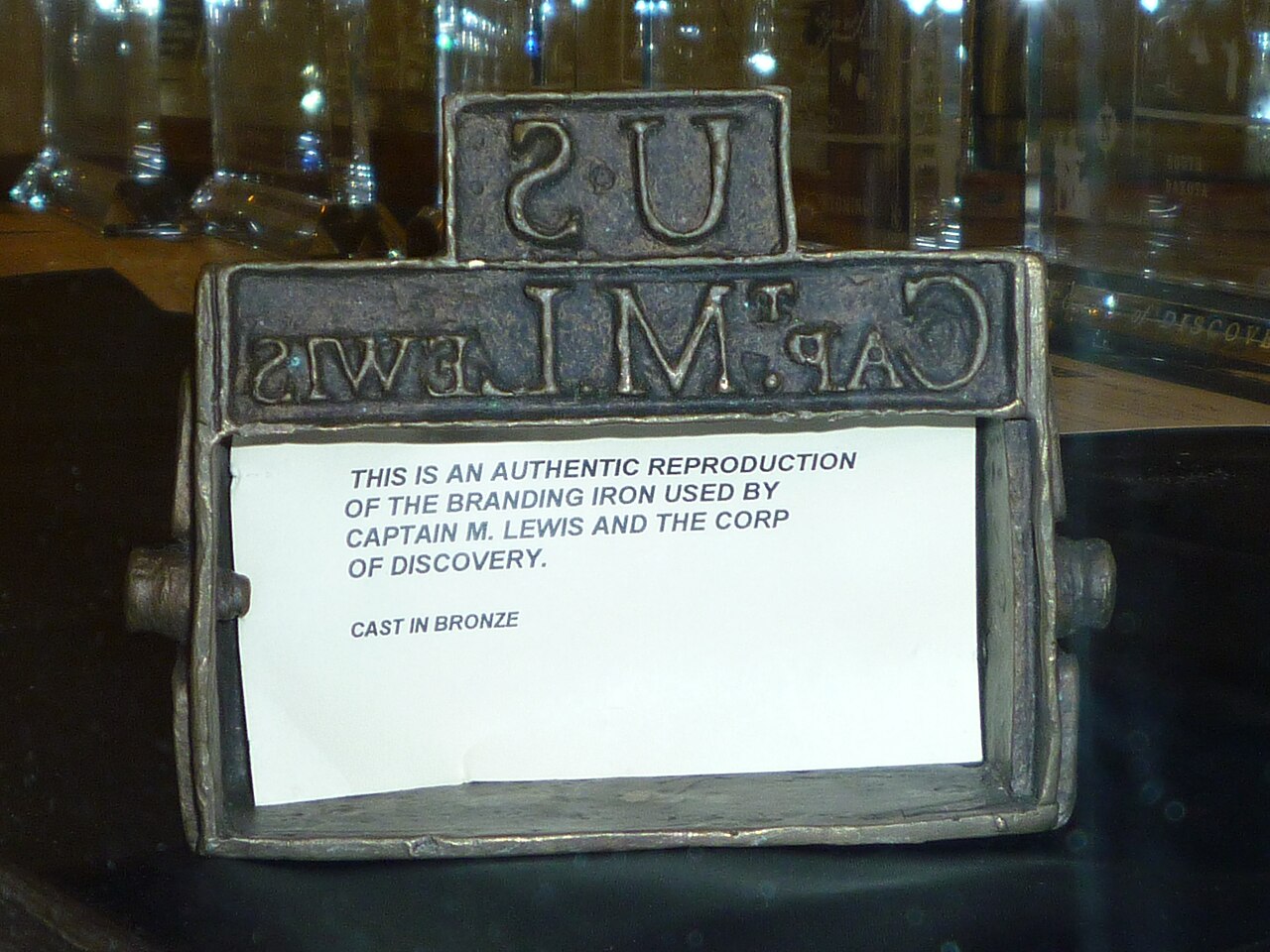
- The US mint prepared special silver medals called Indian Peace Medals for distribution to tribes.
The Chronological Arc of a Multi-Year Undertaking
This five-year window frames the expedition not as a single dramatic crossing but as a sustained, multi-year undertaking. The expedition's duration across these years underscores that it was a logistical and organizational effort as much as a geographic one, requiring sustained coordination over multiple seasons before the team could complete its objective and return. The timeline thus reveals an expedition shaped by patience, planning, and the slow accumulation of progress across an entire half-decade.
The American West as a Corridor of Discovery
The defining geographic descriptor of the expedition is that it traveled through the American West. This phrasing is significant because it positions the journey not as a simple east-to-west transit but as a passage through a vast, largely uncharted region that constituted the western portion of the young nation. The fact that the timeline is organized as a progression through this region rather than a single point of arrival implies that the expedition's purpose was as much about the journey itself, the observations made along the way, as it was about reaching any particular terminus. The American West, in this context, was not merely a destination but a corridor of discovery that the expedition traversed over multiple years.
The Journals as a Living Historical Record
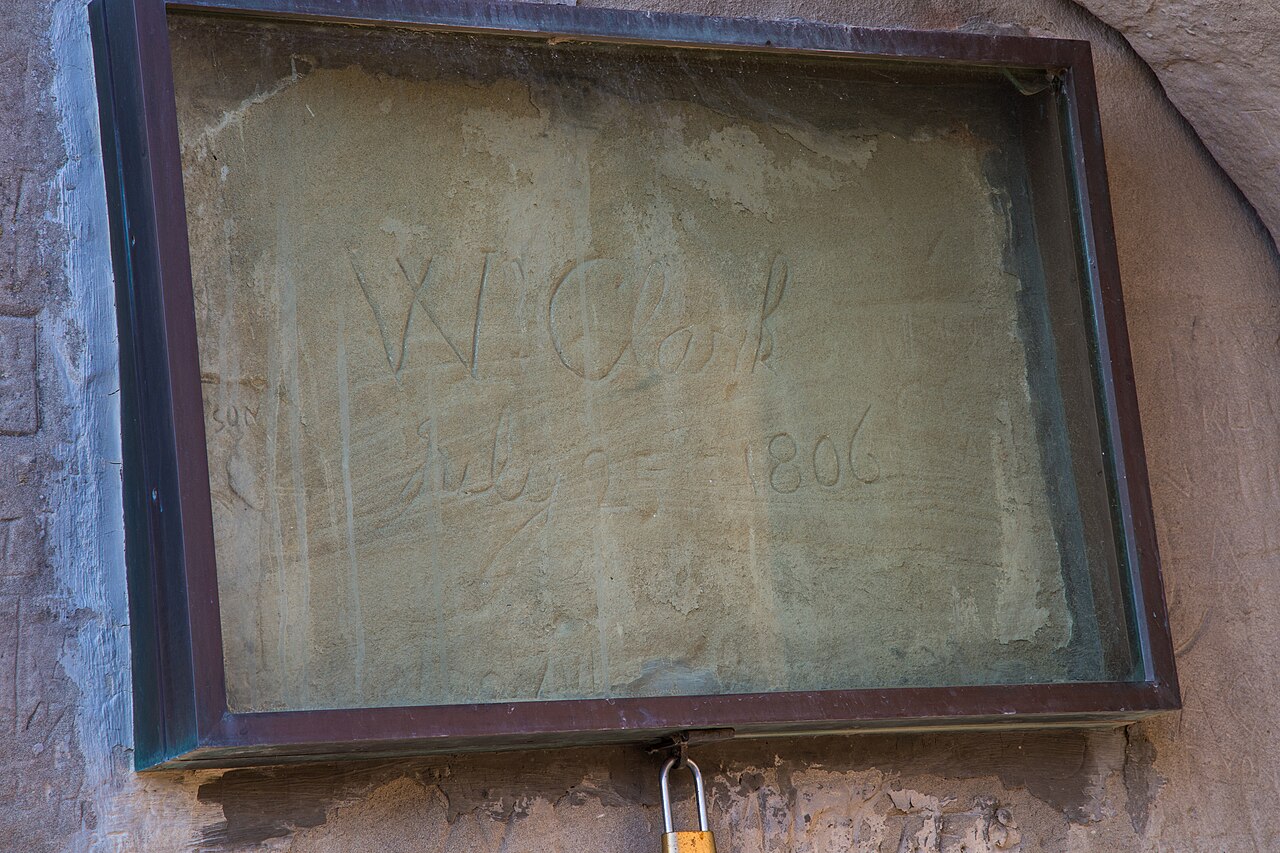
Among the most important artifacts of the Lewis and Clark Expedition are the journals that documented the journey. These journals are preserved and made accessible through an online resource titled Journals of the Lewis and Clark Expedition Online, indicating that the written record of the trip has been digitized for broader public access. The existence of these journals tells us that the expedition was not merely a physical crossing of the American West but also a deliberate act of documentation. The fact that these journals survive and are available online speaks to their historical importance and to the careful record-keeping that accompanied the journey. They represent the primary voice of the expedition, offering a day-by-day account that transforms a sequence of dates into a lived narrative of exploration through the western territories.
Encampments and the Rhythm of the Journey
The timeline of the expedition reveals that the journey was punctuated by specific encampments, periods where the team stopped, rested, and regrouped. This four-day pause during the early phase of the western passage illustrates that the expedition was not a continuous sprint but a rhythm of movement and rest. The specificity of the dates, spanning four days at a named location, suggests that these encampments were significant enough to be recorded as distinct events in the overall timeline. These encampments served as the structural units around which the broader journey was organized.
Common Misconceptions (Editorial)
Some people believe the Lewis and Clark Expedition was solely a military or exploratory mission, but the facts show that secondary objectives included scientific, economic, and humanitarian goals like documenting biodiversity and establishing trade relations with Native Americans. Another common misconception is that the expedition’s main purpose was to simply reach the Pacific, but President Jefferson’s primary goal was actually to find a direct water route across the continent for commerce.
Why It Matters (Editorial)
The Lewis and Clark Expedition endures as a defining moment in American exploration because it transformed vague geographical assumptions into precise maps and scientific records of the West. Its blend of military discipline, diplomatic outreach to Native tribes, and scientific curiosity set a lasting model for how the United States would engage with its expanding frontier.
Gallery
Frequently Asked Questions
Who is The Lewis and Clark Expedition?
It is the Corps of Discovery, a hand-picked team of U.S. Army personnel and civilian volunteers led by Captain Meriwether Lewis and his close friend Second Lieutenant William Clark. They are best known as the first American party to travel overland from the Mississippi region to the Pacific Coast and return.
What is The Lewis and Clark Expedition's role in the Great Explorers canon?
Their core mission was to survey, map, and document the vast Louisiana Purchase territory on behalf of the young United States. They also sought a practical western trade route and a way to assert American sovereignty across the continent.
Why is The Lewis and Clark Expedition important?
It delivered the first thorough American geographic and scientific survey of the continental interior, from the Great Plains to the Pacific. Their recorded observations of flora, fauna, Indigenous peoples, and the Continental Divide remain a cornerstone of U.S. western history.
More in Great Explorers 1-22
Spotted an error? Know more?
This is a living reference — every entry is fact-audited, and reader corrections feed straight into our audit queue. Suggest an edit · See this site's audit record