
Ibn Battuta
Pre-modern explorer who travelled over 117,000 km across three continents.
Ibn Battuta (24 February 1304 – 1368/1369) was a Maghrebi Muslim traveller, explorer and scholar from Tangier (in present-day Morocco). Over a period of 30 years from 1325 to 1354, he visited much of Africa, Asia, and the Iberian Peninsula. Near the end of his life, Ibn Battuta dictated an account of his journeys, titled A Gift to Those Who Contemplate the Wonders of Cities and the Marvels of Travelling, commonly known as The Rihla. Ibn Battuta travelled more than any other explorer in pre-modern history, totalling around 117,000 km (73,000 mi), surpassing Zheng He with about 50,000 km (31,000 mi) and Marco Polo with 24,000 km (15,000 mi).
- born
- 24 February 1304
- died
- 1368/1369
- field
- Traveller, explorer, scholar
- nationality
- Maghrebi (from Tangier, present-day Morocco)
- known_for
- Extensive travels across Africa, Asia, and the Iberian Peninsula; author of The
Lore & Background
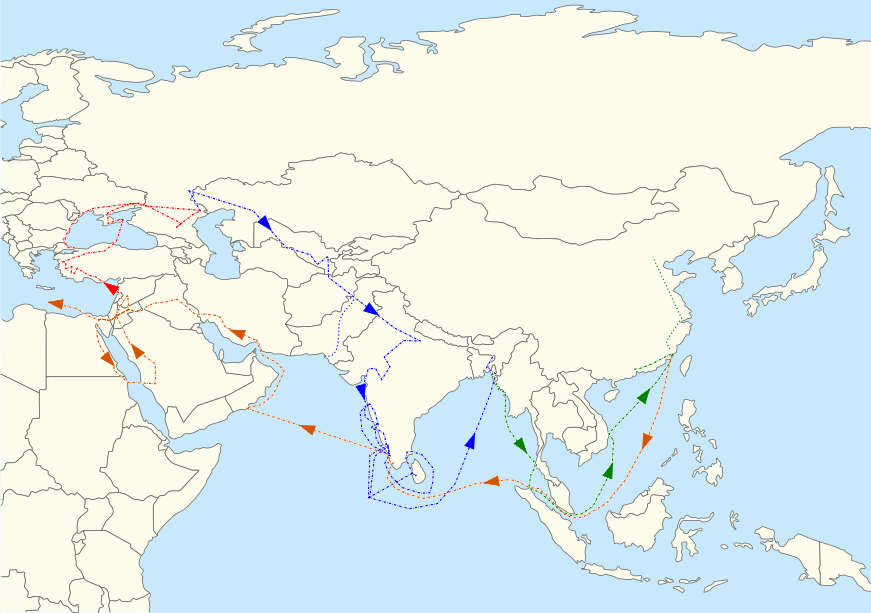
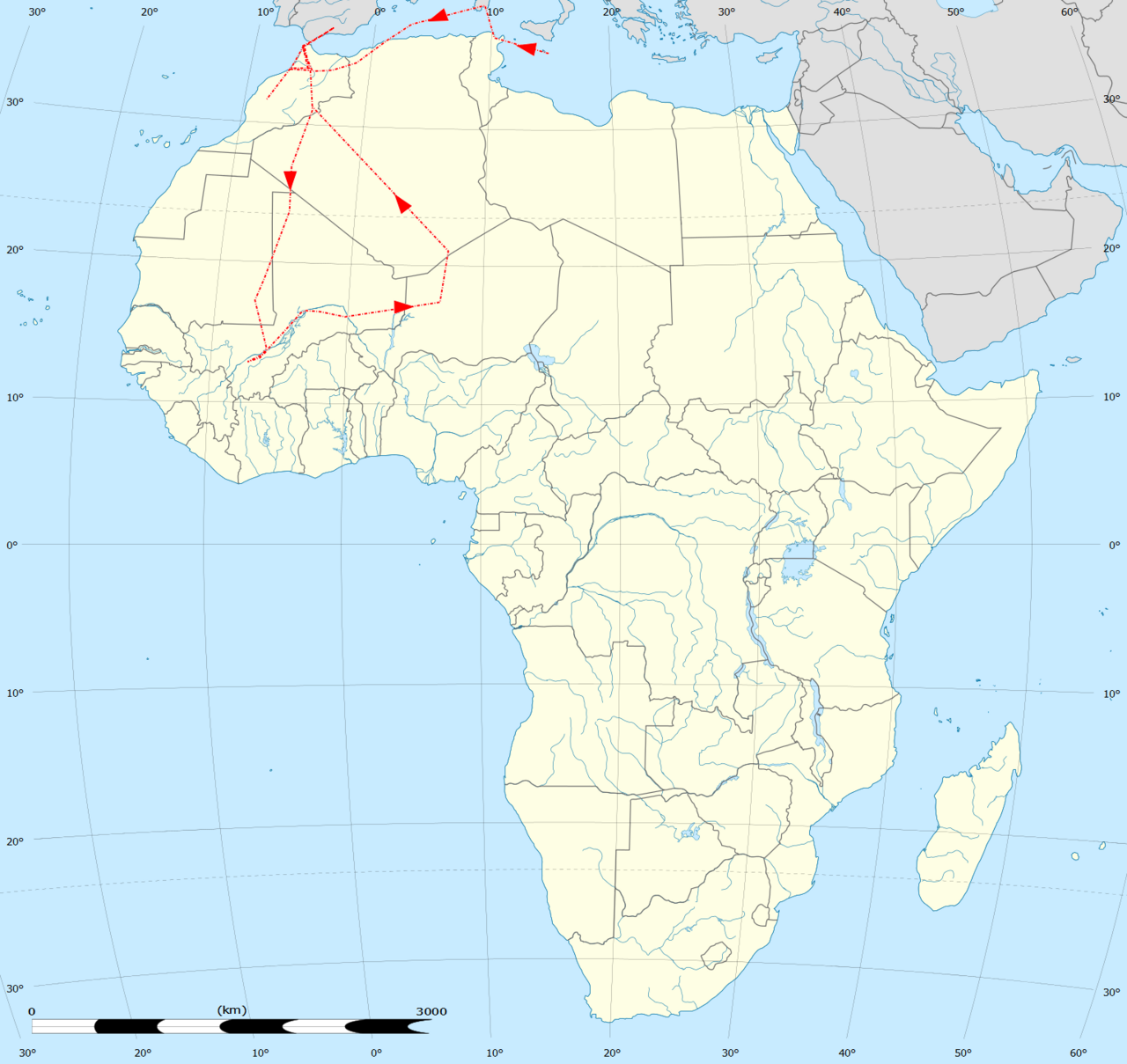
Ibn Battuta was born into a family of Islamic legal scholars in Tangier on 24 February 1304, during the reign of the Marinid dynasty. His family belonged to a Berber tribe clan known as the Lawata. As a young man, he would have studied at a Sunni Maliki school. On 2 Rajab 725 AH (14 June 1325 AD), at age 21, he set off from his home town to perform a hajj to Mecca, a journey that would ordinarily take sixteen months. He would not return to Morocco again for 24 years. He travelled overland along the North African coast, through Tlemcen, Béjaïa, and Tunis, and arrived at Alexandria in early spring 1326. There he met two ascetic pious men: Sheikh Burhanuddin, who foretold his destiny as a world traveller and told him to visit his brothers in India, Sind, and China, and Sheikh Murshidi, who interpreted a dream as meaning he was meant to be a world traveller. He then went to Cairo, and after a detour to Damascus, he joined a caravan travelling 1,300 km south to Medina, then journeyed on to Mecca, completing his first pilgrimage in November 1326, earning the honorific status of El-Hajji.
Reader's Guide
Ibn Battuta's significance lies in the unprecedented scope of his travels, which covered much of the known world of the 14th century. His dictated account, The Rihla, provides a detailed record of the societies, cultures, and political structures he encountered, from the Mamluk Sultanate to the Mongol Ilkhanate, from Yemen to Somalia. The work is a key source for historians studying the medieval Islamic world, offering insights into trade routes, religious practices, and daily life. His travels surpassed those of earlier explorers like Marco Polo and Zheng He in distance, and his observations remain valuable for understanding the interconnectedness of Afro-Eurasia before the modern era. The Rihla also reflects the author's personal experiences, including his marriages, encounters with holy men, and the challenges of travel, such as illness and robbery. Despite some chronological uncertainties in the text, it stands as a monumental achievement in travel literature.
Did You Know?
- Ibn Battuta's patronymic literally means 'son of a duckling'.
- He travelled more than any other explorer in pre-modern history, totalling around 117,000 km (73,000 mi), surpassing Zheng He (about 50,000 km) and Marco Polo (24,000 km).
- He left Tangier on 14 June 1325 at age 21 and did not return to Morocco for 24 years.
- In Alexandria, a sheikh named Burhanuddin foretold that Ibn Battuta would visit his brothers in India, Sind, and China.
- The Rihla is the only source of biographical information about Ibn Battuta; no independent letters or court records exist.
The Unmatched Scale of a Pre-Modern Odyssey
Between 1325 and 1354, a young man from Tangier covered a distance that would not be rivaled for centuries. Over roughly three decades, Ibn Battuta traversed an estimated 117,000 kilometers—about 73,000 miles—threading his way through much of Africa, across vast stretches of Asia, and into the Iberian Peninsula. No other explorer in the pre-modern world came close to matching that span. The Chinese admiral Zheng He, whose voyages are often cited as the nearest parallel, covered approximately 50,000 kilometers, while Marco Polo's legendary journey through the Mongol Empire amounted to roughly 24,000 kilometers. Ibn Battuta's total was more than double Zheng He's and nearly five times Polo's. What makes the figure remarkable is not merely its size but the era in which it was achieved: no steam engines, no printed maps, no established postal networks. Every kilometer was walked, ridden, or sailed by hand, through deserts, mountain passes, and open seas, often in caravans assembled for safety against bandits. The sheer physical endurance required, sustained across three decades of continuous movement, places his achievement in a category of its own within the history of human exploration.
A Son of the Lawata: Identity and Formation
Ibn Battuta was born on 24 February 1304 in Tangier, a port city on the North African coast that today belongs to Morocco. His family traced its roots to the Lawata, a Berber tribal clan, though by his generation they had become fully Arabised in language and culture. The household belonged to the scholarly class of Islamic legal judges, known as qadis, a hereditary role in the Marinid dynastic system that governed the region. As a boy he would have received his education at a Sunni Maliki school, the dominant form of religious instruction across North Africa at the time. His patronymic, "Ibn Battuta," translates literally as "son of a duckling," a modest and slightly whimsical family name that belies the grandeur of his full designation: Shams al-Din Abu 'Abdallah Muhammad ibn 'Abdallah ibn Muhammad ibn Ibrahim ibn Muhammad ibn Yusuf Lawati al-Tanji ibn Battuta. Because he hailed from a region where the Maliki school of jurisprudence was standard, communities he met along his travels would single him out to serve as their religious judge, a testament to the authority his training carried.
The Departure and the First Pilgrimage
On 14 June 1325, a twenty-one-year-old Ibn Battuta left Tangier alone, with no caravan to join and no companion. His purpose was the hajj, the sixteen-month pilgrimage to Mecca. Yet what drove him was a hunger for distant lands and an irresistible inner pull he could not suppress. He would not set foot in Morocco again for twenty-four years. His route followed the North African coast through the sultanates of Abd al-Wadid and Hafsid, passing Tlemcen, Béjaïa, and a two-month stay in Tunis. In Sfax he took a bride, only to abandon her after a quarrel with her father—the first of several marriages that would punctuate his wanderings. By early spring of 1326, after more than 3,500 kilometers, he reached Alexandria, where a sheikh named Burhanuddin foretold that his destiny lay in visiting brothers of his in India, Sind, and China. In Cairo he chose the least-traveled route to Mecca, up the Nile toward the Red Sea port of Aydhab, but an uprising forced him to turn back. He detoured through Damascus, spent Ramadan there, then joined a caravan heading south to Medina before pressing on to Mecca, where in November he completed his pilgrimage and earned the honorific El-Hajji.
The Rihla: A Life Rendered in Words
Near the end of his life, Ibn Battuta dictated an account of his journeys. The work carried the title A Gift to Those Who Contemplate the Wonders of Cities and the Marvels of Travelling, though it is far better known by its shorter Arabic name, The Rihla. What makes this text extraordinary is its singular role as the sole window into his existence. Every biographical detail we possess—his Lawata Berber origins, his family's lineage of qadis, his marriages, his detours, his encounters with sheikhs and sultans—survives only because he chose to record it in this one autobiographical document. There are no independent letters, no court records, no third-party chronicles that corroborate or supplement his narrative. The Rihla is, in effect, both the subject and the source. He gives his own full name within its pages, a long chain of patronymics anchoring him in a specific family, city, and religious tradition. His decision to dictate his story near the close of his life transformed a personal odyssey into a permanent record, ensuring that the man who covered 117,000 kilometers would be remembered not as a name in a registry but as a voice speaking across centuries.
Common Misconceptions (Editorial)
Some assume Ibn Battuta was simply a pilgrim who made one trip to Mecca, but he actually spent 30 years traveling across Africa, Asia, and the Iberian Peninsula. Others might think another pre-modern explorer like Marco Polo traveled the farthest, but Ibn Battuta’s roughly 117,000 km (73,000 mi) is far more than Marco Polo’s 24,000 km (15,000 mi). Also, while his travels were extraordinary, The Rihla is the only source of biographical information about him—no independent letters or court records exist.
Why It Matters (Editorial)
Ibn Battuta endures as a symbol of pre-modern globalism, a man whose 30 years of travel linked distant cultures long before the age of European exploration. His firsthand accounts of Africa, Asia, and the Iberian Peninsula offer an invaluable window into the 14th-century world, reminding us that curiosity and scholarship have always driven human connection across vast distances.
Notable Quotes (Wikiquote)
"Lahari Bandar (Sindh) . The Rehalã of Ibn Battûta translated into English by Mahdi Hussain, Baroda, 1967, p. 10." — Ibn Battuta "[The presents sent by Muhammad bin Tughluq to the Emperor of China included] ‘one hundred male slaves and one hundred slave song- stresses and dancers from among the Indian infidels” (p. 151)." — Ibn Battuta "quoted in The History and Culture of the Indian People, Delhi Sultanate, vol.6. page 627." — Ibn Battuta "“The inhabitants of Habanq are infidels under protection (zimma) from whom half of the crops which they produce is taken; besides they have to perform certain duties” (p. 241)." — Ibn Battuta
Gallery
Frequently Asked Questions
Who is Ibn Battuta?
Ibn Battuta was a 14th-century Muslim scholar and traveller from Tangier in present-day Morocco who spent roughly three decades journeying across Africa, Asia, and the Iberian Peninsula. He is widely regarded as the most extensive explorer of the pre-modern world.
How far did Ibn Battuta travel in his lifetime?
His journeys covered approximately 117,000 kilometres (about 73,000 miles) over a 30-year span from 1325 to 1354. That distance surpasses the travels of both Marco Polo and Zheng He, making him the most travelled explorer before the age of modern navigation.
What is The Rihla and why is it significant?
The Rihla, whose full title translates to 'A Gift to Those Who Contemplate the Wonders of Cities and the Marvels of Travelling,' is the dictated account of Ibn Battuta's journeys composed near the end of his life. It stands as one of the most detailed travel narratives produced in the entire medieval period.
Why is Ibn Battuta important in the history of exploration?
He showed that a single individual could cross three continents using only the networks of Islamic scholarship, trade, and hospitality available in the 14th century. His record of distance and geographic range predate the European Age of Discovery and exceed those of any other pre-modern traveller.
When and where was Ibn Battuta born, and when did he die?
He was born on 24 February 1304 in Tangier, in what is now Morocco, and died in 1368 or 1369. He lived as a Maghrebi Muslim whose primary vocation was travel and the study of foreign cities and cultures.
More in Great Explorers 1-22
Spotted an error? Know more?
This is a living reference — every entry is fact-audited, and reader corrections feed straight into our audit queue. Suggest an edit · See this site's audit record